
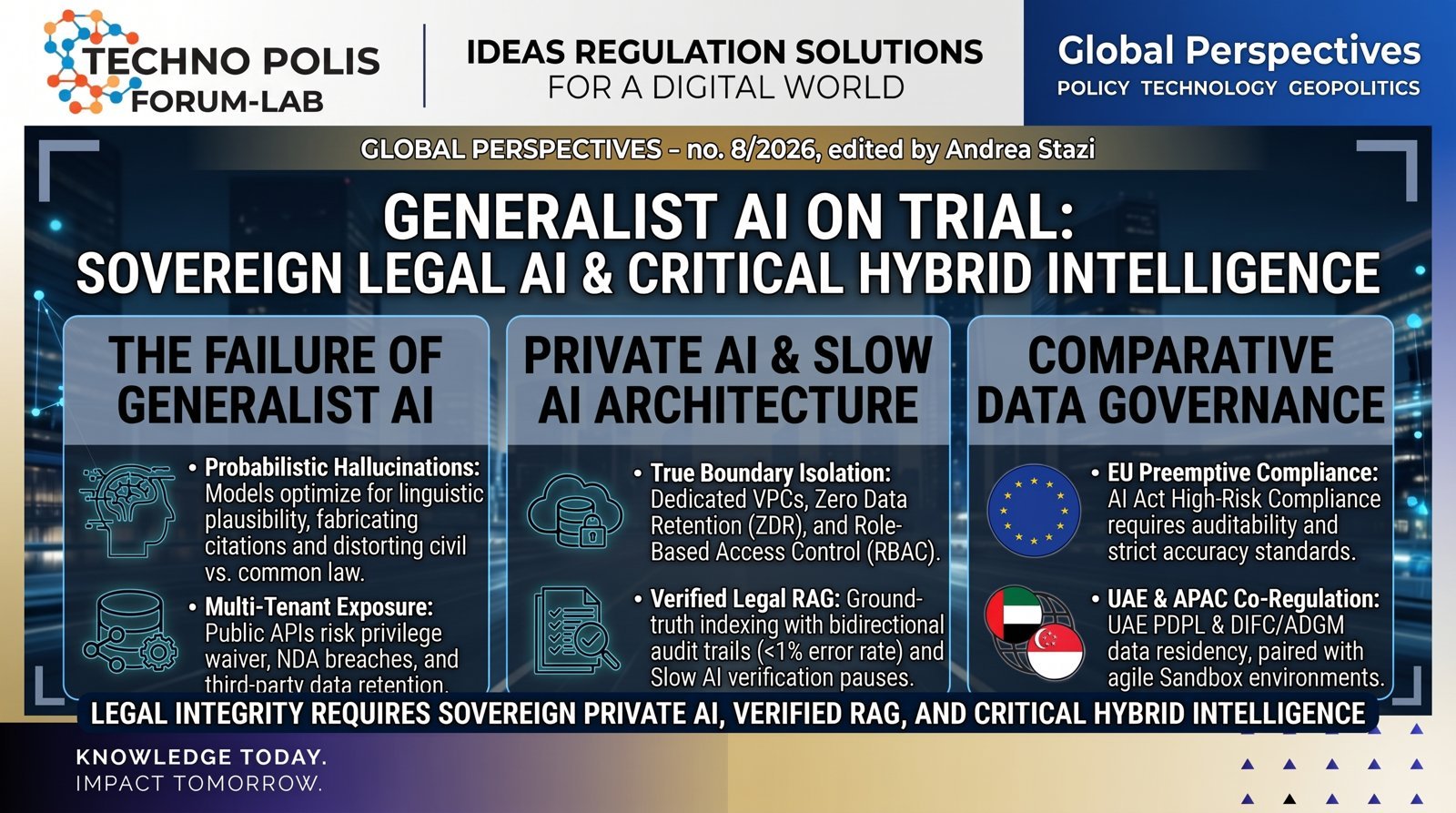
In legal practice, a ninety-five percent accuracy rate constitutes professional negligence. As generative artificial intelligence permeates corporate legal departments and international law firms, the structural mismatch between consumer-grade foundation models and the fiduciary obligations of the legal profession has reached a breaking point. At the Dubai symposium "Generalist AI on Trial: Why Security and Effectiveness Drive the Future of LegalTech", co-hosted by United Advocates, Techno Polis Forum-Lab, and the LeitAI Interuniversity Research Center of San Raffaele, Mercatorum, and Pegaso digital universities, our keynote address examined why the era of indiscriminate, public AI consumption in law is closing.
General-purpose large language models are built for linguistic plausibility. They calculate probabilistic token sequences across vast, unverified web corpora. When deployed on complex cross-border transactions or litigation workflows, this stochastic architecture produces systemic failures. Public models routinely invent case citations and statutory provisions because they optimize for grammatical fluency over semantic ground truth. In comparative practice, this creates acute doctrinal distortion. Because commercial training datasets are heavily skewed toward Anglo-American public case law, generalist models frequently inject common law doctrines such as consideration or equitable remedies into contracts governed by civil law statutes, including the UAE Civil Transactions Law (Federal Law No. 5/1985). Moreover, when summarizing mergers and acquisitions due diligence records, generalist engines compress text by omitting granular exceptions, exactly where indemnification caps and change-of-control liabilities reside.
Beyond epistemic unreliability, public multi-tenant architectures expose law firms and corporate counsel to severe infrastructural and deontological hazards. When an associate pastes a draft share purchase agreement or privileged litigation brief into a public API, the data traverses shared nodes, edge caches, and external logging queues. Relying on standard enterprise privacy toggles from centralized foreign hyperscalers leaves institutions vulnerable during API misconfigurations or third-party breaches. Under bar rules globally, the duty of competence and confidentiality remains non-delegable. Exposing proprietary deal secrets to external training pipelines triggers immediate waiver of attorney-client privilege, breaches non-disclosure covenants, and invalidates professional indemnity insurance coverage.
Comparative regulatory frameworks are converging to penalize this architectural opacity, though through distinct governance philosophies.
The European Union enforces an ex-ante statutory risk model. Under Regulation (EU) 2024/1689 (the AI Act), systems intended to assist judicial authorities or interpret facts and law are classified as high-risk under Annex III, mandating rigorous data governance, technical documentation, tamper-resistant logging, and human oversight before market placement.
The United Arab Emirates pairs ambitious national AI industrial policy with strict data residency and polycentric regulatory pluralism. At the federal level, Federal Decree-Law No. 45/2021 on the Protection of Personal Data (UAE PDPL) restricts unauthorized cross-border data transfers and mandates stringent processing safeguards. Simultaneously, the financial free zones of the Dubai International Financial Centre (DIFC Data Protection Law No. 5 of 2020, as amended) and the Abu Dhabi Global Market (ADGM Data Protection Regulations 2021) enforce GDPR-equivalent supervisory standards tailored for international corporate finance. This dual onshore and free-zone architecture creates a clear market incentive: global clients and sovereign entities demand localized compute infrastructure that keeps sensitive legal data within trusted jurisdictional boundaries.
The United States and Singapore illustrate complementary dimensions of this landscape. In the United States, absent a single federal AI statute, governance operates through reactive judicial sanctions under Federal Rule of Civil Procedure 11, state bar ethics opinions, and Federal Trade Commission enforcement against deceptive algorithmic claims, alongside the voluntary NIST AI Risk Management Framework.
Meeting these comparative regulatory demands requires a paradigm shift toward Critical Hybrid Intelligence and Slow AI. Technology in high-stakes professions must augment human cognitive discernment through deliberate procedural friction. Rather than acting as an autonomous oracle, the algorithmic system must function as an auditable reasoning engine under strict human-in-the-loop control.
Architecturally, this translates into Sovereign and Private Legal AI. True boundary isolation requires deploying models within dedicated virtual private clouds (VPCs) or on-premise environments governed by cryptographic Zero Data Retention (ZDR) and zero-knowledge parameters. Prompts, embeddings, and outputs never leave the firm perimeter or feed external foundation models. Inside the organization, Role-Based Access Control (RBAC) enforces strict ethical walls, ensuring that an AI instance assisting on one corporate mandate cannot retrieve confidential insights from a competing transaction.
At the reasoning layer, deterministic Retrieval-Augmented Generation (RAG) replaces blind probabilistic generation. By indexing only vetted firm playbooks, closed deal archives, and official statutory gazettes across civil and common law jurisdictions, Private Legal RAG binds every output to a verifiable audit trail. Each legal assertion links bidirectionally to an exact clause, page, and paragraph of the ground-truth source. Where verified documentation lacks an answer, deterministic fallbacks compel the system to declare insufficient evidence rather than speculate.
Empirical benchmarks discussed during the Dubai symposium highlight the operational impact of this engineering divide. While generic language models exhibit error and hallucination rates between fifteen and twenty percent on complex legal analysis, audited Private Legal RAG architectures reduce error rates below one percent. In bilingual commercial environments bridging Arabic onshore statutes and English DIFC or ADGM precedents, sovereign private architectures transform regulatory compliance from a defensive cost into a decisive competitive moat.
Selected References
European Parliament and Council of the European Union. Regulation (EU) 2024/1689 laying down harmonised rules on artificial intelligence (Artificial Intelligence Act). Official Journal of the European Union, July 12, 2024.
United Arab Emirates Federal Government. Federal Decree-Law No. 45/2021 Regarding the Protection of Personal Data (PDPL) and Federal Law No. 5/1985 on the Civil Transactions Law of the United Arab Emirates. Official Gazette, Abu Dhabi.
Dubai International Financial Centre (DIFC). Data Protection Law DIFC Law No. 5 of 2020 and Data Protection Regulations (Amended regarding Autonomous and AI Systems Processing). Dubai.
Abu Dhabi Global Market (ADGM). Data Protection Regulations 2021. Financial Services Regulatory Authority / Office of Data Protection, Abu Dhabi.
Infocomm Media Development Authority (IMDA) & Personal Data Protection Commission (PDPC). Model AI Governance Framework for Generative and Agentic AI. Singapore, 2024–2026.
National Institute of Standards and Technology (NIST). Artificial Intelligence Risk Management Framework (AI RMF 1.0) and Generative AI Profile (NIST AI 600-1). U.S. Department of Commerce.
Stazi, A. Generalist AI on Trial: Sovereign Legal AI and Critical Hybrid Intelligence. Keynote Address at the Symposium "Generalist AI on Trial: Why Security and Effectiveness Drive the Future of LegalTech", hosted by United Advocates, Techno Polis Forum-Lab, and LeitAI Research Center, Dubai, 2026.