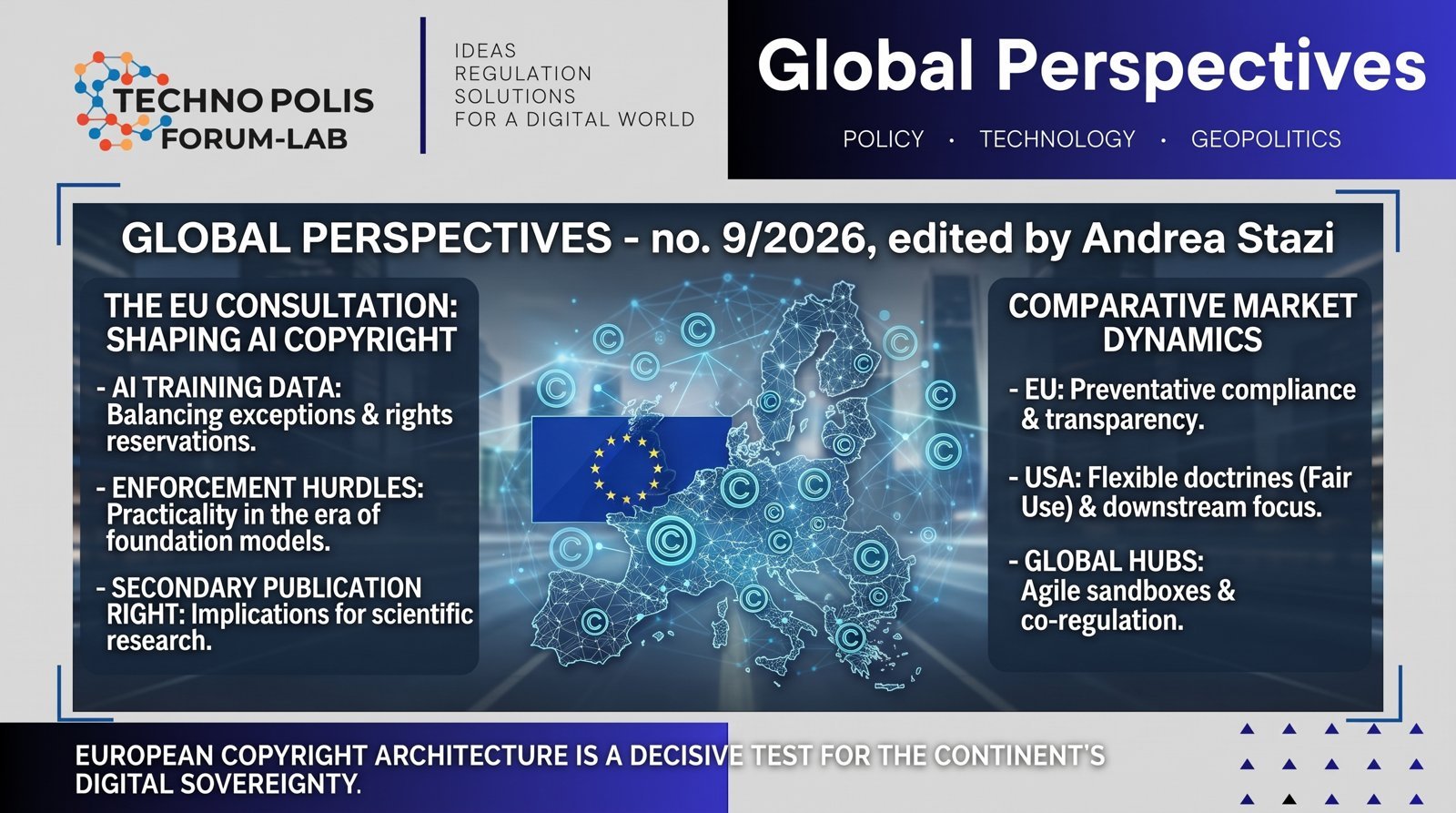
The European Commission has concluded a pivotal targeted consultation examining potential reforms to the EU copyright framework to foster creativity, research, and innovation. Centered on the implementation of the Digital Single Market (DSM) Directive and its interaction with the Artificial Intelligence Act (Regulation (EU) 2024/1689), the initiative scrutinizes how copyright-protected content is utilized across the entire artificial intelligence lifecycle—from foundational model training and retrieval-augmented generation to synthetic outputs.
At the heart of the debate lies a fundamental tension: rightholders face severe practical hurdles in enforcing rights and securing fair remuneration, whereas artificial intelligence developers require massive, high-quality datasets to build competitive foundation models. In response to this critical consultation, Techno Polis submitted a formal contribution (Contribution ID: c5a40e51-fdc6-4147-8e3c-88d607f66633) advocating for legal clarity, workable rights reservations, and internationally interoperable standards[cite: 1, 10, 25].
The Techno Polis Contribution: Interoperability over Fragmentation
In its official submission, Techno Polis addressed the core challenges of text and data mining (TDM) exceptions and rights reservations under Article 4 of the DSM Directive. Key elements of the Techno Polis position include:
Clarification of TDM Scope: Techno Polis supports a targeted legislative clarification confirming that AI training lawfully falls within the TDM exception where statutory conditions—such as lawful access and the absence of an effective opt-out—are met.
Rejection of EU-Only Registries: Rights reservation tools and opt-out protocols must be built on open international standards rather than mandatory centralized registries or regional technical silos that burden researchers and small and medium-sized enterprises (SMEs).
Proportionality in Enforcement: The contribution cautions against imposing disproportionate burdens on web crawlers, retroactive data retention mandates, independent audits, or legal presumptions of non-use that require providers to prove a negative across petabyte-scale datasets.
Voluntary Marketplaces: Licensing frameworks should rely on voluntary marketplaces and model contractual clauses rather than mandatory collective licensing or blanket remuneration rights that undermine statutory exceptions.
Comparative Perspectives: EU Preventative Compliance vs. Global Market Dynamics
A comparative evaluation demonstrates a deep philosophical fracture across global jurisdictions regarding intellectual property and technological sovereignty. The European Union pursues a model anchored in preventative compliance, stringent transparency obligations under the AI Office, and rigorous ex-ante risk categorization.
Conversely, the United States anchors its digital economy in flexible, judicially interpreted doctrines of fair use, allowing technology developers greater operational latitude during early training phases while addressing downstream output infringements. Meanwhile, dynamic innovation hubs such as Singapore and the United Arab Emirates implement agile, pro-innovation sandboxes and light-touch regulatory frameworks designed to attract global venture capital, secure sovereign compute infrastructure, and accelerate commercial deployment. This divergence creates distinct competitive asymmetries, forcing international developers to navigate rigid compliance walls in Europe while operating in more permissive environments elsewhere.
Research Exceptions and the Secondary Publication Right
Beyond commercial generative artificial intelligence, the consultation evaluated barriers to cross-border scientific research and the potential introduction of a harmonized European Secondary Publication Right (SPR). Techno Polis emphasized that academic collaboration suffers from fragmented national implementations of existing research exceptions under the Infosoc Directive.
Allowing authors of publicly funded research to make their accepted manuscripts publicly accessible without restrictive embargoes would significantly enhance scientific diffusion. However, such measures must be carefully calibrated to protect sustainable publishing models, respect contractual freedom, and avoid transforming open access into an unrestricted right for commercial third-party reuse.
Conclusion
The ongoing reform of Europe's copyright architecture is a decisive test for the continent's digital sovereignty. As argued in the Techno Polis contribution, imposing duplicative compliance duties and isolated technical barriers risks marginalizing European startups and research institutions in the global race for frontier intelligence. A competitive European strategy requires robust protections for creators combined with agile, interoperable legal pathways that encourage data-driven innovation.
References
European Commission, Targeted consultation on a potential initiative for a better copyright environment for European creativity and innovation, Call for evidence published in May 2026, Consultation period May–November 2026.
European Parliament, Report on Copyright and generative artificial intelligence (2025/2058(INI)), March 2026.
Techno Polis, Contribution to the European Commission's Targeted Consultation on Copyright (Contribution ID: c5a40e51-fdc6-4147-8e3c-88d607f66633), submitted November 9, 2026.
European Union, Directive (UE) 2019/790 on copyright and related rights in the Digital Single Market (DSM Directive), April 17, 2019.
European Union, Regulation (UE) 2024/1689 (Artificial Intelligence Act), June 13, 2024.
Directive 2001/29/EC (Infosoc Directive), May 22, 2001.
US Copyright Office, Copyright and Generative Artificial Intelligence Study, 2025-2026.
Monetary Authority of Singapore (MAS), Responsible AI and Data Governance Framework for the Financial Sector, 2026.
UAE Government, National Strategy for Artificial Intelligence 2031, 2026 update.